Migrating Siemens S7-300 to Yaskawa VIPA SPEED7 in a Live Plant
A staged plan for migrating Siemens S7-300 PLCs to Yaskawa VIPA SPEED7 in a running Pakistani plant - program porting, module cross-referencing, pilot bays, and cutover windows under IEC 61131.
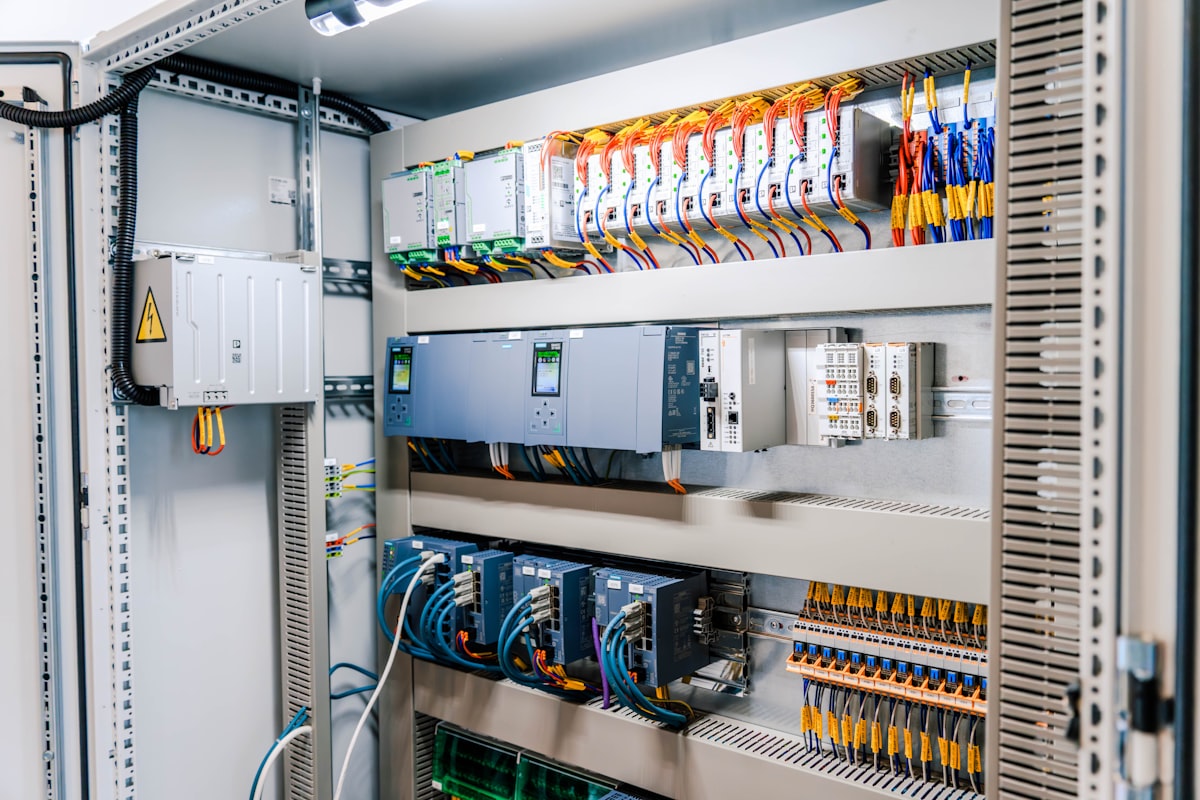
Hundreds of Pakistani production lines still run on Siemens S7-300 controllers that Siemens has moved past - the platform's successors are the S7-1200/1500 on TIA Portal, a different engineering environment and a full rewrite for most legacy programs. When an aged CPU fails on a ring frame or a dyeing line, the plant faces an unplanned choice between hunting spares for a retired platform and re-engineering the line from scratch.
Yaskawa VIPA's SPEED7 controllers exist for exactly this position: System 300S+ CPUs are protocol-compatible with the S7-300 and programmable in the STEP 7 V5.x environment the plant already owns [1][2]. This guide lays out a staged migration that keeps the plant running - the approach the Yaskawa VIPA textile guide introduced, taken bay by bay.
Why SPEED7 Is the Natural S7-300 Successor
The migration cost of a PLC platform is mostly software and wiring, not the CPU price. SPEED7 attacks both: the 300S+ line is S7-300 protocol-compatible, most module classes are pin-compatible, and existing STEP 7 ladder, FBD, and STL programs port with minor adjustments rather than a rewrite [1][2]. Programming stays within IEC 61131-3's standardised languages [4], through STEP 7 V5.x, VIPA's SPEED7 Studio, or WinPLC7 - no TIA Portal licence required. Cycle times are sub-millisecond for typical control logic, verified against the specific CPU datasheet [1].
What Ports From S7-300 and What Needs Checking
Compatibility is broad but not unconditional - the discipline is a module-by-module check:
| Element | Ports cleanly | Verify first |
|---|---|---|
| Ladder / FBD / STL program | most native S7 logic [1] | per-OB/FB against the CPU manual |
| Digital I/O modules | most pin-compatible [3] | terminal-by-terminal cross-reference |
| Analog and special modules | - | module-by-module against the cross-reference [3] |
| CPs and comms | PROFIBUS DP / PROFINET via SPEED7 | conformance per CPU datasheet |
| HMI / SCADA links | S7 protocol connections | tag addressing after CPU swap |
The cross-reference [3] is the load-bearing document: analog inputs, communication processors, and special function modules are exactly where "mostly compatible" needs a named part number on both sides before anything is ordered.
A 5-Stage Plan for a Running Plant
A live plant migrates in bays, not big bangs. The 5-stage sequence that keeps production up:
| Stage | Work | Plant state |
|---|---|---|
| 1. Survey | Inventory CPUs, modules, firmware, program blocks | running |
| 2. Cross-reference | Map every module to its 300S+ part [3] | running |
| 3. Pilot bay | Migrate one non-critical machine; run in parallel | running |
| 4. Staged cutover | Swap bay by bay in planned windows | short stops |
| 5. Rollback ready | Keep the old rack wired until sign-off | protected |
The pilot bay is the risk killer: it proves the ported program, the module map, and the crew's procedure on one machine before the critical lines move. Because the 300S+ speaks the S7 protocol, SCADA and HMI connections carry over with tag verification rather than re-engineering [2].
Programming Tools: STEP 7 Without a Rewrite
The plant's existing STEP 7 V5.x projects remain the working base - SPEED7 CPUs accept them with per-block verification against the CPU manual [1]. Where a fresh environment is preferred, SPEED7 Studio covers the full IEC 61131-3 language set [4], and the controllers themselves meet the equipment and EMC requirements of IEC 61131-2 [5]. The practical rule: pick one engineering environment per plant and standardise, so a decade of mixed maintenance does not create two program dialects.
Common S7-300 Migration Mistakes
The recurring S7-300 migration failures are process errors, not product ones:
- Claiming 1:1 compatibility without part numbers. Compatibility holds per module and generation - name the S7-300 module and its 300S+ replacement from the cross-reference [3], every time.
- Skipping the pilot bay. Porting a program per the manual and proving it on a machine are different facts; pilot first.
- Migrating analog and special modules blind. These are the known exception areas [3] - verify before ordering, not at commissioning.
- Cutting over without rollback. Keep the old rack wired until the new bay has run a full production cycle.
- Quoting scan-time gains as fixed. SPEED7 is fast, but interrupt handling differs in edge cases - cite the CPU datasheet for the application class [1].
What to Specify When Enquiring
An S7-300 migration enquiry that quotes cleanly states:
- Installed base - CPU part numbers, rack layouts, and module list per line
- Program inventory - STEP 7 version, block count, and any special OBs/FBs in use
- Comms map - PROFIBUS/PROFINET nodes, HMI/SCADA connections and tags
- Criticality ranking - which lines can take a planned stop, and the pilot candidate
- Engineering environment - STEP 7 V5.x continuity or a move to SPEED7 Studio [4]
- Spares strategy - target stock of CPUs and I/O for the migrated fleet
Sourcing and Support in Pakistan
Pacific Engineering & Automation is the authorized Yaskawa VIPA reseller in Pakistan. We supply the System 300S+ and 500S CPU lines, SLIO decentralised I/O, and compact controllers, and support the survey, cross-referencing, and pilot stages of an S7-300 migration before any cutover is scheduled. The new controllers drive the same panels covered in the LV distribution board guide from Tempa Pano, and their outputs belong behind the interposing relays in the Shenler interface relay guide from Shenler.
To scope an S7-300 migration for your plant, request a catalogue or quotation or contact our engineering team.
Field-derived case studies will be added to this post as Pacific Engineering & Automation accumulates engagement records. The current version is grounded in published specifications, regulatory documentation, and standards body references.
Sources
- Yaskawa VIPA 300S+ product overview
- Yaskawa VIPA SPEED7 technology - S7-300 compatibility
- Siemens S7-300 to Yaskawa VIPA 300S+ part-number cross-reference
- IEC 61131-3:2013 - Programmable controllers, Part 3: Programming languages
- IEC 61131-2:2017 - Programmable controllers, Part 2: Equipment requirements and tests
Pacific Engineering & Automation
Need industrial equipment in Pakistan?
Authorized dealer and reseller for 16 international manufacturers. Karachi-based, serving Pakistan since 1995.